Who better to break down the reality of modern team transformation than our own Jen Southern FCIPD? As Hive’s Head of Professional Services and a seasoned CIPD fellow, Jen has spent over two decades helping UK organisations get out of the dugout, move past box-ticking data, and actively lead their people through complex cultural change.
Here, she sets the tactical playbook for what it really takes to get HR in the game when the world of working is changing, and yes, we are stretching this football analogy to its absolute limit—especially now that artificial intelligence is completely changing the rules of how our squads operate
Executive summary
In business, just like in football, you can’t win the match if you only focus on the stadium finance and ignore the players on the pitch.
As AI shifts the workplace, managing your team merely as a spreadsheet expense leads to locker-room resentment, dropping morale, and failed transitions. True leadership requires moving past box-ticking surveys and using continuous employee feedback as your matchday intelligence.
Key takeaways
- The revenue reality: Organisations in the top quartile of employee engagement see a 21% boost in profitability and a 59% reduction in turnover. They understand that people are not an expense; they are the product.
- The transformation risk: 70% of tech-driven transformations fail due to cultural resistance. Maintaining psychological safety increases team productivity by 17% during periods of intense AI integration.
- The data lag dilemma: Relying on standard 12-month annual surveys introduces a dangerous operational delay. Continuous listening channels allow HR to predict turnover trends up to 90 days before they hit the balance sheet.
“Imagine buying a football club. You’ve secured the stadium, locked in the kit deal, and settled the broadcast rights. Because you want to prove your strategic worth to the board, you spend your energy, your meetings, and your reviews on ticket pricing. On merchandise margins. On car park revenue and half-time hospitality.
Meanwhile, the players? Their fitness, their form, their relationships with each other, what motivates them when they are 1–0 down with twenty minutes left on a freezing Tuesday night? Barely a mention.
It would be laughed out of any serious boardroom. The players aren’t a cost to be managed. They are the entire reason anyone is in the stadium. Their performance is the product. Everything else, every sponsorship deal, every broadcast contract, every season ticket, flows entirely from what they do on that pitch.

And yet that’s almost exactly how a remarkable number of UK organisations think about their people. Costs on a spreadsheet. Headcount to be optimised. Problems to be processed by HR. The business of work swirls around them, the systems, the processes, the quarterly reporting, while the humans actually playing the game remain, at best, an afterthought.
In a service-led, knowledge-based economy where your people quite literally are the product, this isn’t just a philosophical mistake. It’s a commercial one. And what’s coming next is about making it impossible to hide.”
“ Too many organisations manage everything around their people rather than investing in the people themselves. As AI accelerates that tension to a crisis point, HR has a choice about which side of history it wants to be on.”

Jen Southern FCIPD, Head of Professional Services at Hive HR
Nobody sees the edges of it coming
“In 2004, Mark Zuckerberg built what he thought was a simple way for Harvard students to connect online. Within a couple of years it had crossed the Atlantic, and by the time I was in my second year studying psychology in Manchester in 2006, we were all on it. None of us really stopped to ask what we’d just signed up for.
That’s the thing about inflection points, you can’t see the edges of them when you’re standing on the precipice. What started as a university tool became a force that rewired geopolitics, mental health, and democracy. Nobody planned that. By the time the technology becomes a normal part of daily life, the rules of the game have already changed completely.
Artificial intelligence is that moment. Right now. And the question isn’t whether it will reshape how your squad operates—it already is. The question is who’s paying attention to the players living through that reshape.
History is pretty consistent on who gets called up from the bench when the world shifts and it involves people. When the pandemic turned the world of work on its head overnight, it wasn’t operations who led the tactical response. It wasn’t finance, though they were certainly in the room. It was HR—often without the budget, the headcount, or frankly the credit—who held organisations together while the rules were being rewritten in real time.

The organisations that win won’t be the ones that moved fastest on AI. They’ll be the ones that understand their players well enough to move wisely.
The challenge is that the urgency rarely feels proportionate to the reality… until you’re already a goal or two behind. Which is why at Hive, we decided to move before anyone was asking us to.”
The Hive story: Rethinking the tactical formation
“Nearly a year ago, we started quietly rethinking our Professional Services model from the ground up. At that point, our team’s expertise was largely deployed customer by customer, producing survey data, generating insight, delivering reports. Valuable work, sure. But it was the equivalent of reviewing game tape weeks after the match was lost.
We could already see that technology was going to transform it, and we had a choice: let automation reduce what the team did, or use it to dramatically expand what they could do.
We chose the latter. It meant being honest about what a winning formation required, including restructuring the team, bringing in new consultancy depth, and getting very clear on what human expertise actually looks like when it’s freed from repeatable tasks. It took twelve months from the first tactical conversation to telling our customers. Change takes longer than you think it will, which means you need to kick off sooner than feels necessary.”
6 things we actually did to change the game
- Restructured, deliberately: We brought in a colleague with a broader consultancy background to deepen our practice. Restructuring wasn’t a squad reduction; it was a reinvestment in the high-tier skills the next chapter actually needs.
- Launched the Employee Voice Academy: Working with our marketing team, we built Hive’s first Academy, toolkits, templates, and thought leadership content. Our expertise is no longer rationed by billable hours. It scales.
- Moved customers from data reliance to strategy: Automated reporting gives customers instant access to insight they used to wait for us to produce. That frees everyone to focus on the more important questions: So what? What’s the next tactical play? Where’s the injury risk in the squad?
- Elevated our executive offer: We’re no longer just sharing raw stats in boardrooms. We’re bringing strategic counsel, interrogating what the data means, where the risk sits, and what the impact of inaction looks like. That’s a different conversation entirely.
- Initiated the Employee Voice Exchange: A space for customers to connect with each other, sharing experience, challenges, and match tactics. Community is part of the value now. The best insights don’t always come from the coaching staff.
- Invested in our own people: We brought in a team coach and created more space for learning and growth without increasing headcount or budget. You can’t model a winning culture for customers that you’re not living by yourself in your own clubhouse.
“None of this was frictionless. We took some knocks on the pitch along the way, as any honest transformation does. But we came out the other side stronger, more connected to each other, and clearer on our purpose.
We believe every voice has the power to change their working world. Rebuilding our model around that belief, rather than around the administrative tasks that once defined us, is what made the difference.”
What this means for HR leaders
“Our experience isn’t unique, but the willingness to move before the pressure arrives is rarer than it should be. Here is how you lead through this transition from the technical area:
Reframe people as capability
Every conversation about AI should start with a human capability audit. What can your players do now? What will they need to do in two years? That gap is your entire training strategy.
Speak the board's language
Engagement and wellbeing aren’t soft, fluffy metrics. They are leading indicators of performance, player retention, and commercial profit. Draw the line to the commercial outcome, and draw it clearly.
Lead the culture, not just the process
AI transformation isn’t a systems installation project. It’s a human experience. The squad watches what leadership does, not just what it says. HR is uniquely placed to make that experience legible, fair, and if you get it right, even energising.”
The commercial and tactical focus

The players are already on the pitch. The question is whether anyone in the ownership box is watching the game, and whether HR is ready to step up, get out of the dugout, and be the manager that makes the difference.”
We’re incredibly proud of how our team navigated this tactical shift, and we’re happy to share the scars and the successes we picked up along the way. Because if every voice has the power to change their working world… that includes ours.
If you are currently mapping out a similar transition in your organisation, trying to figure out how to keep your squad secure, or looking to position your people function for what’s coming next, let’s grab a coffee.
Whether you need structured coaching, strategic consultancy, or just a sounding board for your next big tactical play—our Professional Services team would love to chat.“
Don’t wait for your next board meeting to start building your roadmap. If you want a taste of how automated intelligence can instantly supercharge your strategy, use Hive’s interactive tool right now.
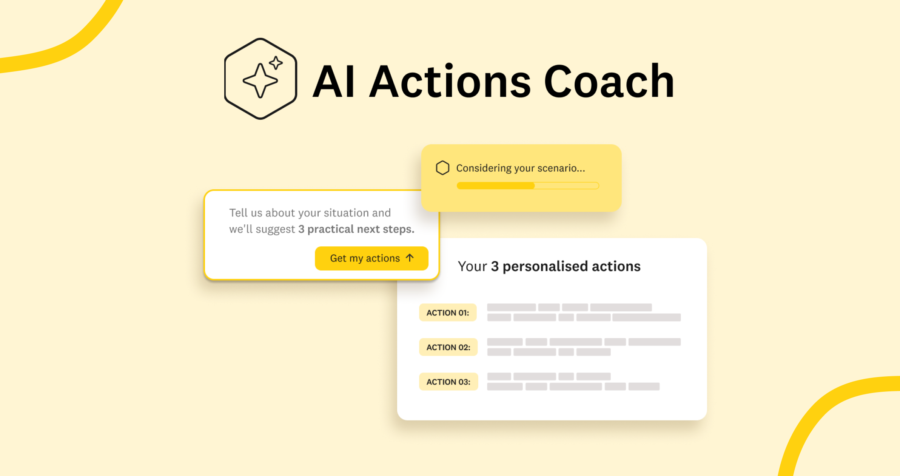
Use our free AI Actions Coach to transform your current employee feedback into a concrete, 3-step action plan in seconds.