
HR teams are heading into 2026 under sustained pressure. AI is accelerating across recruitment, learning, analytics and HR operations. Managers are being asked to deliver more with less support. Expectations around engagement, wellbeing and psychological safety continue to rise, while pay pressure, retention risk and skills gaps remain a constant backdrop to decision-making.
This isn’t about predicting what’s next. It’s about understanding where HR strategies are most likely to stall, based on what organisations are already experiencing.
The six priorities on this page are grounded directly in Hive’s Professional Services analysis, based on feedback from HR Professionals and organisational insight across a wide range of sectors and organisation sizes. The analysis has been led by employee voice expert, Georgie Brown and reflects real delivery challenges HR teams and managers are facing today, not theory or aspiration.

“These aren’t abstract trends. They’re the realities shaping HR delivery right now, and they represent clear opportunities for HR teams to strengthen impact, support managers, and build trust if they’re acted on deliberately.”
— Georgie Brown, Professional Services

Hive’s Professional Services analysis shows that AI is now present across most HR functions, but adoption is uneven and confidence remains low.
Our survey shows that while 62% of organisations have started integrating AI tools, a further 32% have only limited adoption and 6% have not yet implemented AI at all. No organisations describe AI as fully embedded into HR delivery.
Most organisations are adopting AI incrementally rather than transforming HR end-to-end. Pilots are running, tools are being introduced, and use cases are emerging, yet HR teams, managers, and employees are not consistently confident in how AI should be used or explained.
“What we’re seeing isn’t a lack of ambition around AI, it’s a lack of confidence. HR teams know it matters, but managers and employees are often unsure how it fits into real work. The organisations making progress are the ones treating AI as a ‘people change first,’ not a technology rollout.”
— Georgie Brown, Professional Services
This mirrors wider market data. External research suggests that only around 4% of organisations report formal AI integration in HR (HR Review, 2025), reinforcing what we’re seeing in practice.
Employees are unsure how AI will affect their roles. Managers don’t feel equipped to explain it or embed it into everyday work. Leaders struggle to maintain consistency when adoption varies across teams. The result isn’t rejection — it’s hesitation.
Where organisations slow down to listen and support managers, AI adoption is steadier and trust holds. Where they don’t, uncertainty fills the gap.
Teams that feel heard and supported adopt AI faster, reduce fear, and maintain engagement. The key isn’t adopting AI faster, it’s listening to concerns early, giving managers clear actions, and visibly closing the feedback loop.
When AI is introduced without evolving how HR and managers work, organisations see limited returns. In their 2026 Top Priorities report, Gartner finds that changing the HR operating model delivers the highest AI productivity gains — more than skills or acceptance alone — highlighting the cost of treating AI as a bolt-on rather than a people-led change.
When employees don’t understand how AI affects their role, or feel their concerns aren’t being heard, uncertainty grows. Over time, this erodes trust in leadership and HR, leading to lower engagement and reduced willingness to participate in future initiatives or feedback cycles.
Unaddressed concerns often turn into passive resistance. Decisions take longer, initiatives stall, and AI becomes something teams work around rather than with, slowing down broader organisational strategy.
Gather feedback before and during rollout to understand concerns, expectations, and levels of confidence. Early listening helps HR address issues proactively and positions AI as something shaped with people, not imposed on them.
Look for patterns that signal low readiness, such as confusion, fear about impact, or lack of manager capability. This allows HR to focus support where it will make the biggest difference, rather than treating all teams the same.
Share what’s happening, what decisions have been made, and what support is in place. Showing employees that feedback leads to action helps build trust and momentum as AI adoption progresses.
Our research shows that organisations with 251–5,000 employees consistently lead adoption across AI, HR systems, learning platforms, wellbeing and people analytics.
This is also the dominant context in our data: 55% of survey respondents work in organisations with 251–5,000 employees, making this the segment where innovation pressure is most visible.
These organisations are often large enough to face enterprise-level complexity, but without the same levels of specialist resource or infrastructure. As a result, they tend to move faster, experiment more, and feel delivery pressure more acutely.
This insight matters because it explains where many of the risks and opportunities across the other priorities are most concentrated.
“Mid-sized organisations are moving fast, often faster than their structures were designed for. That creates a huge opportunity, but also real pressure. HR teams here are constantly balancing scale, complexity and limited resources, which is why being deliberate about priorities matters so much.”
— Georgie Brown, Professional Services
Mid-sized organisations are often:
Understanding this context helps HR leaders benchmark realistically and prioritise where simplification, pacing and support are most needed.
When organisations underestimate the operational complexity of being mid-sized, HR approaches remain informal and fragmented. Processes that once worked start to creak under scale, leading to inconsistency, duplicated effort and growing frustration for both managers and employees.
Without deliberate design, managers quietly absorb complexity that should sit with systems, clarity or HR support. Over time, this increases workload, reduces confidence and contributes to burnout, particularly when multiple initiatives land at once.
Mid-sized organisations often adopt multiple platforms quickly to solve specific problems. Without a clear operating model, this leads to overlapping tools, unclear ownership and lower return on investment, as teams struggle to connect insight, action and outcomes.
Sense-check whether current HR processes, decision-making and delivery models still work at your current size. What was manageable at 150 people may create friction at 1,500.
You can’t simplify everything at once. Focus on the areas that create the most friction for managers and employees, such as feedback follow-up, change communication or role clarity, and design those with scale in mind.
Make it clear what sits with HR, what managers are responsible for, and where tools provide support. Clear boundaries reduce overload and improve consistency across teams. Action planning tools can help with outlining these roles with clarity.
Regular listening helps surface where growth has created confusion, overload or inconsistency. These signals allow HR to intervene early, before issues become embedded or harder to unwind.
Hive’s Professional Services analysis shows that blended models are now the norm.
This is reflected directly in our survey responses. Very few HR leaders describe relying on a single delivery channel. Most report a mix of digital platforms, manager-led activity and selective in-person connection across learning, wellbeing and engagement.
In practice, this means being clear about who delivers what, through which channels, and why — rather than letting learning, wellbeing and engagement evolve through a mix of tools, managers and activities without clear ownership.

Digital platforms
Online tools and learning

Manager-led activity
Coaching and check-ins

In-person moments
Workshops and meetings
Digital platforms provide scale and consistency. Managers are expected to translate that into real, day-to-day experience for their teams. In-person moments are used more selectively, stepping in where connection, trust or context can’t be replicated through a screen.
When this balance is thought through, blended delivery feels coherent. When it isn’t, the cracks start to show.
“Blended delivery has become the default for many organisations to support wellbeing and engagement, but not always by design. Where it works well, expectations are clear and managers feel supported. Where it doesn’t, people feel pulled in different directions and delivery starts to fray.”
— Georgie Brown, Professional Services
For many HR teams, this hasn’t been a deliberate strategy shift. It’s been a response to pressure. Budgets are tighter. Teams are leaner. Expectations haven’t gone away. Blended delivery is often the most realistic way to keep things moving without overwhelming HR teams or employees.
External research supports this pattern. LinkedIn Learning (2025) reports that 76% of organisations now use a mix of digital and manager-led learning — validating what HR teams are already doing in practice.
The difference is in how consciously that mix is designed.
Where this works well, roles are clear. HR sets direction and priorities. Managers understand what’s expected of them. Digital tools support, rather than replace, human conversations.
Where it struggles, it’s usually because those boundaries aren’t clear:
The challenge for 2026 isn’t whether to use blended models. Most organisations already are. The real question is whether they’re being used intentionally, or whether they’ve simply evolved by default.
When blended delivery isn’t clearly designed, managers quietly absorb more responsibility without the time, clarity or support to deliver well. Over time, this leads to frustration, disengagement and inconsistent follow-up.
Platforms can be rolled out with good intent but low impact if they’re not embedded into everyday work. Without manager ownership or clear use cases, tools risk becoming underused or ignored.
When delivery relies heavily on individual managers without guidance, employees have very different experiences of learning, wellbeing and engagement depending on where they sit in the organisation.
Be explicit about what sits with HR, what sits with managers, and where tools support both. This includes deliberately gathering feedback on how different elements of blended delivery are working — for example, digital tools, manager-led activity and in-person moments — and using tools like Hive Actions to turn that insight into clear actions with defined ownership.
Look for areas where one channel is doing too much of the heavy lifting. If managers feel overloaded or digital tools feel disconnected, it’s a sign the balance needs adjusting.
Regular check-ins help surface where blended delivery feels unclear or overwhelming. Small adjustments, made early, prevent bigger issues from building over time.
Book a demo to explore how Hive supports managers, builds trust, and helps HR teams deliver on today’s priorities.
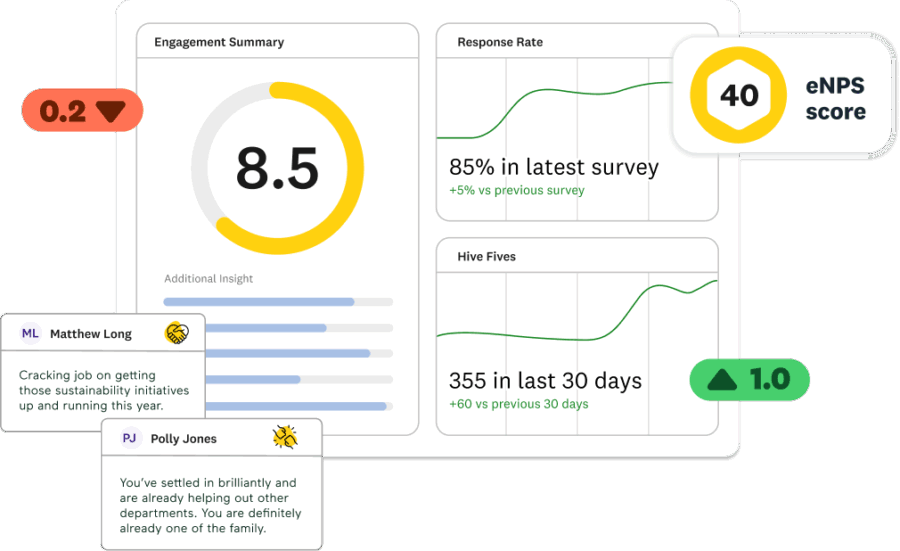
Managers sit at the centre of almost every HR priority for 2026. They’re expected to turn employee feedback into action, support wellbeing, enable learning, lead through change, and create environments where people feel safe to speak up.
Hive’s Professional Services analysis shows that while managers are carrying this responsibility, confidence in their capability remains only moderate.
Only 5% of HR leaders in our survey say they are very confident in manager capability. The remaining 95% report moderate or low confidence, despite managers being central to engagement, wellbeing and change delivery.
This gap matters. Psychological safety doesn’t come from policies or programmes. It’s shaped by everyday manager behaviour: how feedback is handled, how mistakes are responded to, whether concerns are taken seriously, and whether people feel listened to when things feel uncertain or pressured.
When managers don’t feel clear or confident, a few things tend to happen. Feedback stays at report level. Conversations get avoided. Teams become cautious about speaking up. Over time, trust erodes and engagement drops, even when the intent is good.
Where managers are supported with clear priorities, practical guidance and visible backing from HR, the difference is noticeable. Feedback leads to action. Conversations happen earlier. Teams feel safer raising issues, and delivery becomes more consistent.
Ignoring this risk has real consequences. HR strategies can stall, feedback goes unacted upon, and managers, along with their teams, become disengaged. Over time, this erodes trust in HR and limits the organisation’s ability to use insight to influence business outcomes.
When managers lack confidence or clarity, difficult conversations are delayed or avoided. Employees become less willing to speak up, raise concerns or challenge decisions.
Without confident managers, even well-designed initiatives struggle to translate into action. Insight is collected, but impact never quite follows.
Managers feel overwhelmed and unsupported, while teams experience inconsistency and uncertainty. Over time, this damages trust in both leadership and HR.
Rather than asking managers to do everything, prioritise the behaviours that most influence engagement and psychological safety, such as listening well, following up on feedback and having regular, open conversations.
Clear frameworks, examples and prompts help managers move from insight to action with confidence, especially when dealing with sensitive issues.
When managers can see what good looks like and know where to get help, they’re more likely to act. Visibility also helps HR identify where additional support is needed.
“Managers are being asked to carry more of the employee experience than ever before. Most want to do a good job, but without clear priorities and practical support, confidence drops. When HR focuses on enabling managers rather than adding expectations, delivery improves quickly.”
— Georgie Brown, Professional Services
Headline: Where delivery becomes inconsistent
What HR is seeing: You’re asking managers to play a central role in engagement, wellbeing, learning and change. You can see from feedback that some teams are thriving, while others are struggling, but it’s not always clear where capability gaps sit or what support will make the biggest difference.
Common challenges:
What helps:
Clear focus on a small number of high-impact manager behaviours
Rather than asking managers to do everything, prioritise the behaviours that most influence engagement and psychological safety, such as listening well, following up on feedback and having regular, open conversations.
Practical guidance that links directly to employee feedback
Clear frameworks, examples and prompts help managers move from insight to action with confidence, especially when dealing with sensitive issues.
Better visibility into where managers are confident and where they need support
When managers can see what good looks like and know where to get help, they’re more likely to act. Visibility also helps HR identify where additional support is needed.
Headline: Why this role feels heavier than it used to
What managers are experiencing:
You’re expected to support your team’s engagement and wellbeing, respond to feedback, develop people and lead through change, often alongside demanding delivery targets. You want to do the right thing, but it’s not always clear what to prioritise or how to approach more sensitive conversations.
Common challenges:
What helps:
Clear priorities and simple, actionable guidance
Practical direction that helps you understand where to focus your time and what actions will have the greatest impact on your team.
Confidence that you’re focusing on what matters most
Reassurance that you’re not just reacting to noise, but addressing the issues that genuinely affect engagement, performance, and wellbeing.
Support that helps you take action, even when things aren’t perfect
Tools and backing that make it easier to start meaningful conversations and take next steps, without waiting for perfect conditions or complete certainty.
For many HR teams, pay pressure, retention risk and skills gaps aren’t new challenges. What’s changed is how consistently they shape every other decision.
Hive’s Professional Services analysis shows these pressures now form the backdrop to almost all HR activity.


In our survey, 81% of HR leaders plan to increase the influence of HR data and people analytics on executive decision-making in 2026. However, 47% say they are unsure how to implement this in practice, highlighting a significant delivery gap between intent and execution.
They influence how employees respond to change, how much capacity managers have to support their teams, and how realistic it is to deliver new initiatives at pace.
When pay feels misaligned with workload, or skills gaps go unaddressed, engagement and trust are harder to sustain. Managers spend more time firefighting. Employees become cautious about change. Even well-designed programmes struggle to land when people are already stretched.
These challenges don’t sit neatly in one HR workstream. They cut across engagement, wellbeing, learning and retention, and they amplify delivery risk if they’re ignored.
When pay pressure or skills gaps persist without acknowledgement, employees may disengage long before they resign. By the time attrition rises, the warning signs have often been visible for months.
Managers already stretched by operational demands have less time and energy to support engagement, development and wellbeing, increasing burnout on both sides.
Without a clear way to translate people data into decisions, HR initiatives can feel disconnected from day-to-day reality, reducing their impact and credibility.
Regular listening helps identify where pay concerns, workload or skills gaps are most acute, allowing HR to act before issues escalate.
Not every issue can be solved at once. Focusing on the areas causing the greatest strain helps protect engagement and retention while capacity is limited.
Clear communication about what can and can’t be addressed builds trust, even when immediate solutions aren’t possible.
“Pay pressure and skills gaps don’t sit neatly in one HR programme, they shape how people experience everything else. The teams that cope best are the ones that surface pressure early and are honest about trade-offs, rather than trying to fix everything at once.”
— Georgie Brown, Professional Services
Across our research, one signal stands out consistently: engagement and psychological safety rise or fall based on whether employees trust leadership to listen, communicate clearly, and follow through on what they hear.
This isn’t about having more messages, more updates or more initiatives. It’s about whether employees can see a clear line between what they say, what leaders decide, and what actually happens next.
Our survey data reinforces this gap. While most organisations are collecting feedback regularly, only 17% of HR leaders say their people data significantly influences leadership decisions. For employees, this often shows up as uncertainty: they are asked to share input, but don’t always see how it shapes priorities, trade-offs or action.
Where communication is unclear or leadership visibility is low, trust erodes quietly. People become cautious about speaking up. Psychological safety weakens. Engagement drops, not because people don’t care, but because they stop believing their voice makes a difference.
By contrast, organisations that communicate decisions clearly, explain trade-offs openly and show visible progress, even when not everything can be fixed, sustain higher levels of trust and engagement over time.
“Trust isn’t built by collecting more feedback. It’s built when people can see how insight turns into decisions, and when leaders are visible about what’s changing, what isn’t, and why.”
— Georgie Brown, Professional Services
When employees don’t see clear action or explanation, confidence in leadership decisions weakens over time, even if intentions are good.
People become less willing to raise concerns, challenge decisions or share honest feedback, reducing the quality of insight HR receives.
Surveys, initiatives and programmes continue, but participation and belief decline because employees don’t see visible outcomes.
Share not just outcomes, but the reasoning behind them, including what has been deprioritised and why.
Show employees how their input has influenced decisions, even when change is incremental or constrained.
Support leaders to talk openly about progress, trade-offs and next steps, rather than relying on generic updates.
Use feedback to understand whether employees believe action will follow, not just how they feel in the moment.
“As AI adoption, workforce pressure and manager responsibility continue to rise, trust becomes the stabilising force. Clear communication and visible leadership action help employees feel safe, informed and willing to engage, even in periods of uncertainty. The organisations that perform best in 2026 won’t be the ones doing the most. They’ll be the ones that communicate clearly, act visibly, and build belief that listening leads to action.”
— Georgie Brown, Professional Services

Book a demo to explore how Hive helps HR teams listen, prioritise and turn insight into action.